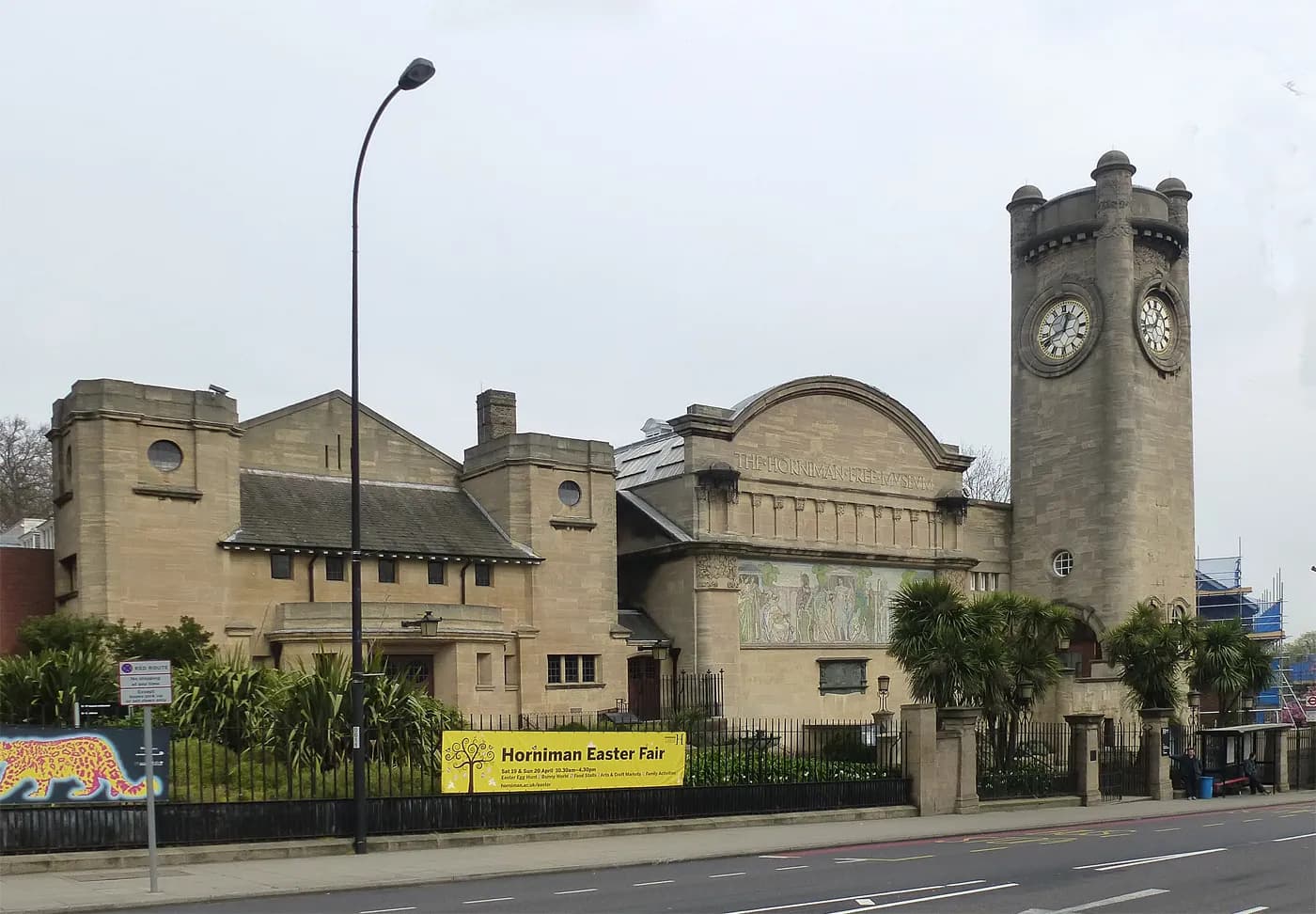
The Horniman Museum in Forest Hill stands as one of Lewisham's most cherished institutions, its distinctive Doulting stone building and 16 acres of Grade II listed gardens drawing visitors from across South London and beyond. The museum's origins lie in the fortune of a Victorian tea trader whose personal passion for collecting grew into a public gift that has shaped the cultural landscape of the borough for more than a century.
From Tea Merchant to Collector
Frederick John Horniman inherited his father's tea business in the mid-nineteenth century. By 1891, Horniman's Tea had become the world's largest tea trading operation. The wealth generated through this enterprise; which the museum today acknowledges benefited from the British opium trade in China and relied on poorly compensated or forced labour on global plantations; funded Frederick Horniman's increasingly ambitious collecting habits.
Beginning around 1860, Horniman travelled extensively to acquire objects, specimens and artefacts. His journeys took him to Egypt, Sri Lanka, Burma, China, Japan, Canada and the United States. The collection soon outgrew his family residence, Surrey House, and on Christmas Eve 1890 he opened the Surrey House Museum to the public. Within nine years, more than half a million visitors had passed through its doors.
A Gift to the People
In 1901, Frederick Horniman formally gifted the museum and its collections to the public. The museum reopened that year in a new purpose-built structure on London Road, designed by architect Charles Harrison Townsend in the Modern Style. The building, now Grade II* listed, remains a landmark in Forest Hill. A supplementary building containing a lecture hall and library was added in 1911, funded by Frederick's son Emslie Horniman and also designed by Townsend.
Horniman himself was active in public life beyond his museum. Elected as a Liberal Member of Parliament in 1895, he campaigned for social reforms while maintaining his commitment to bringing "the world to Forest Hill" and providing educational opportunities for the local community.
Collections and Significance
Today the Horniman holds approximately 350,000 objects across three principal areas: anthropology, natural history and musical instruments. Its ethnography and music collections hold Designated status, recognising their national importance.
The museum's galleries have evolved considerably over the decades. The African Worlds exhibition, opened in 1999, was the first permanent exhibition in Britain dedicated to African art and culture. The World Gallery, unveiled in 2018 following a six-year project to review and redisplay the Anthropology Collections, showcases human cultures from across the globe.
Notable architectural features include a neoclassical mosaic mural titled Humanity in the House of Circumstance, designed by Robert Anning Bell and composed of more than 117,000 tesserae on the London Road wall. A 20-foot totem pole carved by Tlingit artist Nathan Jackson in 1985 stands at the main entrance.
The Gardens and Grounds
The museum's 16-acre gardens are Grade II listed on the Register of Historic Parks and Gardens. Features include a Victorian conservatory dating from 1894, moved to the site in the 1980s; a bandstand from 1912; a Butterfly House opened in 2017; a nature trail established in 1973; and the Animal Walk, which opened in 2013. The Centre for Understanding the Environment building, completed in 1996, was constructed using sustainable materials and features a grass roof.
Contemporary Lewisham
The Horniman remains deeply embedded in the Lewisham community. Educational programmes serve local schools, whilst The Studio, opened in 2018, functions as a social arts space hosting exhibitions co-created by residents, artists and museum staff. The Horniman Market, held on Sundays, features stalls selling local produce.
In 2022, the museum was named Art Fund Museum of the Year. Later that year, it returned 72 items, including Benin Bronzes, to Nigeria's National Commission for Museums and Monuments as part of ongoing efforts to address its colonial legacy.
The Natural History Gallery is currently closed for refurbishment. New additions scheduled for 2026 include the Kusuma Nature Play Area and a redesigned Gardens Cafe. Gordon Seabright was appointed Chief Executive in 2024, leading the institution as it continues Frederick Horniman's original vision of connecting Lewisham residents with global cultures and the natural world.